Thursday, January 30, 2014

Lesson 13 Castle Model

Turtle Lake Student Castles
http://www.artsonia.com/museum/gallery.asp?exhibit=62074&index=12


What are important parts of a castle?

Roll paper to make cylinders.

Press corners into your cylinder if you want it to be a prism instead.

Fold a paper to make a site.

Add details.

Lesson 12 Scratchboard Winter Castles

Draw a castle

http://www.castlexplorer.co.uk/index.html

Turtle Lake Castles at Night


Tuesday, December 31, 2013

Lesson 11 Making scratchboard for Winter Castles

Draw a castle.

Link to castle Powerpoint


Virtual Tour of Warwick Castle, Warwick, England.
http://www.sphericalimages.com/warwickcastle/


Slideshow of Edinburgh Castle
http://youtu.be/RJGzNhh454s


Castle Xplorer has great pictures of many Castles in England, Wales, and Scotland.
http://www.castlexplorer.co.uk/index.html


Everycastle.com has great pictures of castles from all over the world.
http://www.everycastle.com/


Why were castles built?
Why is the selection of the site important?
What forms, shapes and textures do you notice?
What materials do you notice?
How are British castles similar or different from castles in other parts of the world?

Which forms, shapes and textures will you choose for your castle?

On heavy paper, draw the oil pastel colors for your scratchboard.
When your oil pastel is done, it will be dipped in black paint to turn it into scratchboard.  Make sure your name is on it! It will go on the rack.  The black paint needs to dry before it can be scratched.

Is there time left? Start to plan your castle design.
Who is your client?  Why do they want a castle?
Decide on forms, shapes and textures for your castle.  It does not have to look like a British castle.

Draw your castle's elevation (view from outside, looking at the front).
Planning drawing stays here for next time along with scratchboard.

Sketch from beginning of class goes home.


Wednesday, December 11, 2013

Lesson 10 Skyscrapers, Footprints, and Gardens

Use Templates on the geometric side.  Do not use templates on the Organic side.


Now pick up a folded paper.  Can you make it tall like a skyscraper?
Can you change it so that it has a triangle footprint?  A square footprint?


Draw a footprint for your skyscraper.

Add streets, gardens, parks, or anything you like to create your site plan.


If you have time, add windows or other details to your skyscraper.
Do not use any glue today.  Your skyscraper needs to be able to flatten to fit in your take home folder.

Put in your big art take-home folder...
  • Animal Footprint drawing
  • Animal story, if you have one.
  • Painting of a Garden Map
  • Color Wheel
  • Geometric and Organic Shape paper.
  • Skyscraper
  • Skyscraper Site Plan
  • Note for parents


Tuesday, December 3, 2013

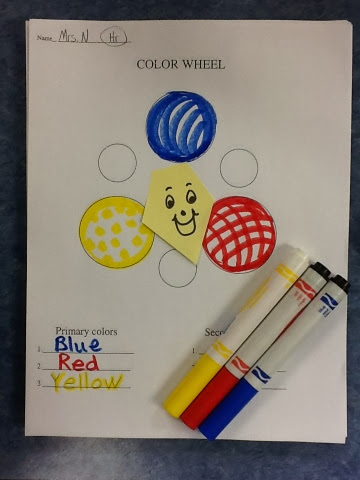
Lesson 9 Paint the Garden

What are the 3 Primary colors?

Draw Patterns in the large circles.
Use a different primary color for each circle.


Write the color words at the bottom of the paper underneath the words "Primary Colors"

Look at the marker for spelling help.


Check your work.
Did you use Red, Yellow and Blue?
It is OK if they are in different circles, as long as you only used the large circles so far.
If you made a mistake, redo your work on the back of the paper.


Find the Secondary Colors.
Color the small circles in secondary colors.


Check your work.
Is the green between yellow and blue?
Is the purple between red and blue?
Is the orange between red and yellow?
If you made a mistake, cross it out and make a new small circle next to the mistake circle.


The first step is to draw the lines of the Garden Plan


The next step is to Paint the Garden Plan


Friday, November 15, 2013

Lesson 8 Garden Plan

Imagine Flying over a garden.  What does it look like?

Does your garden have trees?
Water?
Bridges?
Decks?
Grass?
Vegetables?
Flowers?
Sand?


Does your garden have Geometric or Organic shapes?


These pictures are plan views.

Draw a Plan View of your Garden idea.
Use white and peach oil pastels on gray paper.
Next time we will add more colors with paint.
The paint will not stick to the oil pastel if it is thick enough.


Wednesday, November 6, 2013

Lesson 7 Foot Prints tell a story

Imagine a place your animal is going to visit.  Draw what you imagine.
written by L. Frank Baum, illustrated by W.W. Denslow


Did you Draw your animal in pencil?


Did you add footprints?


If you want to use marker, use it only for outlines or tiny shapes.


Use thick layers of crayon for filling in large areas.


Name and last initial and Homeroom on back. 

Take a new paper.


Tell a story with words or pictures or both. 

Where has your animal been?  Where is it going?

Name and last initial and homeroom on back of both.


Here is a video about the author L. Frank Baum and illustrator W.W. Denslow working together on "The Wizard of Oz".